
Welcome to My Blog

Enjoy Your Time!

Get Your Books Here

See the World Beyond Your Windows

Food

I'd love to eat!

Animation Movies

Best Genre

:)

Thank You for Your Visit

Showing posts with label Japanese Lesson. Show all posts

Sep 22, 2014

Jingisukan (‘Genghis Khan’ – Japanese-Style Grilled Lamb)

The origins of Jingisukan dish
 
This dish takes its name from the 13th century ruler Genghis Khan, the founder of the Mongol Empire that stretched across Eurasia.  
This dish of grilled mutton or lamb was created in Japan about 100 years ago.  Until then neither mutton nor lamb had featured in the Japanese diet.  At the time, mutton conjured up images of Mongolia and the extensive grazing of sheep there.  The name Genghis Khan was already familiar to many Japanese.  It is also possible that this dish was inspired by the Chinese dishes of grilled mutton that Japanese visitors had seen in northeastern China. 
In the late 19th century, the Japanese government encouraged sheep farming as a source of wool.  People were also encouraged to eat mutton to grow bigger and stronger.  This culminated in the dish known as ‘Genghis Khan’.  The authorities occasionally organised events in Tokyo and Hokkaido for people to sample it.  But the dish began to become familiar among Japanese people around the 1930s.  It is still popular particularly in Hokkaido where there is still a lot of sheep farming.
Specialized cast iron pans are available in Japan for Genghis Khan.   The pans have a raised centre to hold the meat, while the surrounding section for the vegetables is shaped like the brim of a hat and designed so that it will catch and coat the vegetables with the meat juices.  Many homes in Hokkaido have these special pans.  They are not used for any other dish.  Genghis Khan holds a rather unique place in Japanese cuisine. 

Mar 2, 2012

Japanese Vocabulary


もちもの           (Mochimono) means goods
めがね            (Megane) means eyeglasses
ほん               (Hong) means book
ぺン               (Pen) means pen
かばん            (Kabang) means bag
ものさし           (Monosashi) means ruler
けしゴム          (Keshigomu) means eraser
くつ                (Kutsu) means shoes
えんぴつ          (Enpitsu) means pencil
ノート              (Nooto) means note*signal of long vowel
きょうかしょ       (Kyokasho) means textbook
じしょ              (Jisho) means dictionary
とけい             (Tokei) means clock
かみ               (Kami) means paper
ふでばこ          (Fudebako) means pencil case
マーカ             (Maka) means marker
かぎ               (Kagi) means key
かびん            (Kabin) means vase

Feb 12, 2012

Gaijin


Gaijin 

Kanji 外人

Hiragana がいじん

 There is an interesting word in Japanese (for me) that is “Gajin”. I heard it for the first time when I watched “Too Fast Too Furious: Tokyo Drift”. What does it mean?
It means “a foreigner” , “a person who does not belong to speaker’s group”, or “A PERSON WHO STANDS OUTSIDE THE CIRCLE”.
All right, then, why am I interested in it?  
I have no reason. We DON’T have to have a reason to interested in something, do we?

Feb 2, 2012

Okonomi-yaki

Ingredients ( 4 portion)
・80 g squid 
・200 g cabbage 
・1 egg  
・100 g flour  
・½ cup water (100ml) 
・½ teaspoon salt (2.5g) 
・Pepper to taste 
・1 teaspoon soy sauce (5ml) 
・Vegetable oil for the frying

For the sauce
・2 tablespoons tomato ketchup (30ml) 
・1 tablespoon soy sauce (15ml) 
・Mayonnaise (optional)

Jan 23, 2012

Sore wa nan desu ka


なん
それは何ですか?(Sore wa nan desu ka?)
What is that?

Kanji and Hiragana from the text above
Hiragana                                                                                                              Kanji
やまだ                         (yamada)                                                                      山田
なん                              (nan)  means what                                                    
めいし                         (meishi) means business card                              名刺
しゃいんしょう    (shainshô) means staff identity card                 社員証
これ (Kore) means this
それ (Sore) means that
あれ (Are) means that (the object is far from both listener and speaker)
どれ (Dore) means which

Jan 16, 2012

Questions in Japanese

Question
Yes/No question
~ ですか?
If the answer is yes: はい、そうです。(Hai, soudesu)
If the answer is no: いいえ、ちがいます。(Iie, chigaimasu)
Example: ほんですか? (Hong desu ka) means is (it) book?


Jan 12, 2012

Japanese Vocabulary 1

ばん( Ban*read as Bang) means number
0 ゼロ (Zero)/ れい (Rei)
1いち (Ichi)
2 (Ni)
3 さん (San)
4 よん (Yon)
5 (Go)
6 ろく (Roku)
7なな (Nana)
8 はち (Hachi)
9 きゅう (Kyu)
10 じゅう (Jyu)

Jan 10, 2012

Introduce Others in Japanese

If we want to introduce our friend, we use this following pattern:
こちらは  ~  です。 (Kochirawa ~ desu* read as des) * read as Wa because it is particle.
Example: I introduce my friend, Suci. こちらはスチさんです。 (Kochirawa Suci san desu) means This is Suci.
Suci is not Japanese name, so we use Katakana to write it. San always follows name.
Actually, we cannot directly say “This is Suci”. We need an opening sentence. That is:
For informal: しょうかいする。(Shoukai suru).
For formal: しょうかいします。(Shoukai shimasu)
So, if I introduce Suci in informal situation, I will say しょうかいする。こちらはスチさんです。


Warm regards
ヘニアティ スリ アグスタ
Heniarti Sri Agusta


Jan 3, 2012

Teng-teng (゛) and Maru (゜)

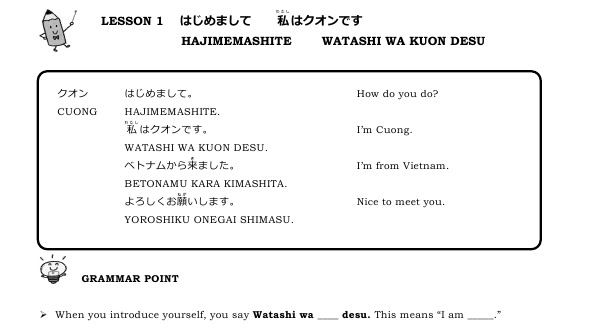
Before learn the next lesson, I want to review and add our last lesson. That is introduction or しょうかい (shôkai).
We have:
 わたし(watashi ) means (I)      
わたしたち(watashitachi) means (we)
あなた(anata) means (you)
When we introduce ourselves in formal situation, we useどうぞよろしくおねがいします。 (Dôzo yoroshiku onegai shimasu) or どうぞよろしくおねがいいたします。 (Dôzo yoroshiku onegai itashimasu) at the end of introduction. When it is in non-formal, it is acceptable just saying どうぞよろしく。 (Dôzo yoroshiku).Then the listener might answer こちらこそ。(Kochira koso) followed byどうぞよろしく。orどうぞよろしくおぬがいします。again, depends on the situation. こちらこそ means I also or I do too.
Ehem..perhaps that is enough. This time we learn about Teng-teng () and Maru ()

Dec 27, 2011

Introduction


Hiragana                                                              Kanji
わたし (watashi)                                                    
(ki)                                                                  
ねが (nega)                                                          

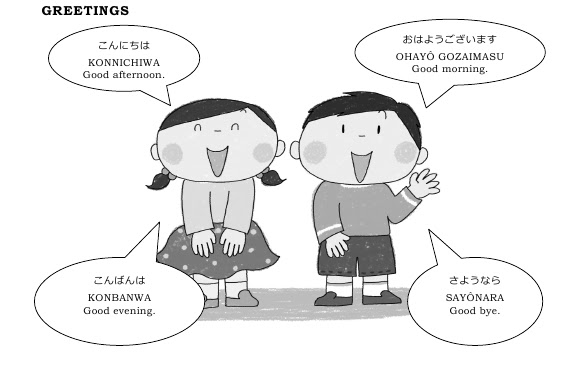
Greetings in Japanese


Dec 26, 2011

Katakana


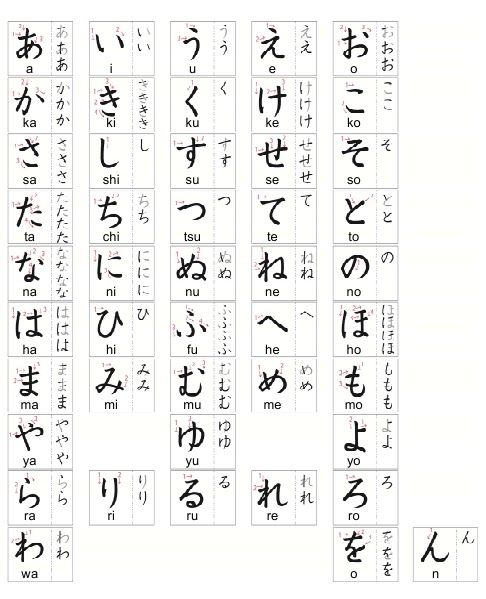
Hiragana